Students and staff of the department where excited with the presence of there ex exam officer in person of mallam Ahmed balarabe sa’id, which was present at the conference.
The joy on the staffs and students faces shows that they have really missed his presence in the department of mass communication and as a lecturer as well.
Mallam Ahmed Balarabe is one of the most popular lecturers in mass communication department. He has been in the department for more than 15years according to him and has delivered his services to the department back to back. One of his most popular exploit in the department was that of the exam cluster he created in order to aid the arrangement of sitting arrangements amongst students of the department.
The cluster system was introduced by Mallam Ahmaed Balarabe in 2021 and became an aiding success to curtailing exam malpractice in the department,It was one of the most popular exploits he has done in the department and is being remembered for.
At a two days conference held by the mass communication department with the theme:COMMUNICATION FREEDOM GOVERNANCE AND REGULATION IN DIGITAL ERA:ISSUES, CHALLENGES AND OPTIONS.
Students and staff of the department where excited with the presence of there ex exam officer in person of mallam Ahmed balarabe sa’id, which was present at the conference.
The joy on the staffs and students faces shows that they have really missed his presence in the department of mass communication and as a lecturer as well.
Mallam Ahmed Balarabe is one of the most popular lecturers in mass communication department. He has been in the department for more than 15years according to him and has delivered his services to the department back to back. One of his most popular exploit in the department was that of the exam cluster he created in order to aid the arrangement of sitting arrangements amongst students of the department.
The cluster system was introduced by Mallam Ahmaed Balarabe in 2021 and became an aiding success to curtailing exam malpractice in the department,It was one of the most popular exploits he has done in the most popular exploit he has done in the department and his being remembered for .
Presently there is an on going build under construction in the Kaduna state polytechnic suspected to be class rooms
It’s a massive project that from it outlook its look like an upstairs story building. The polytechnic said to be the largest subsahara polytechnic and the largest polytechnic in the northern part of Nigeria.
The building is a massive project that led to evacuation of some shops from where it’s been suitable .
The construction let me equation of some cafe shops and food vendors the buildings just to create an adequate space to contain the building
Currently the building is one of the most anticipated building to be completed within the polytechnic.
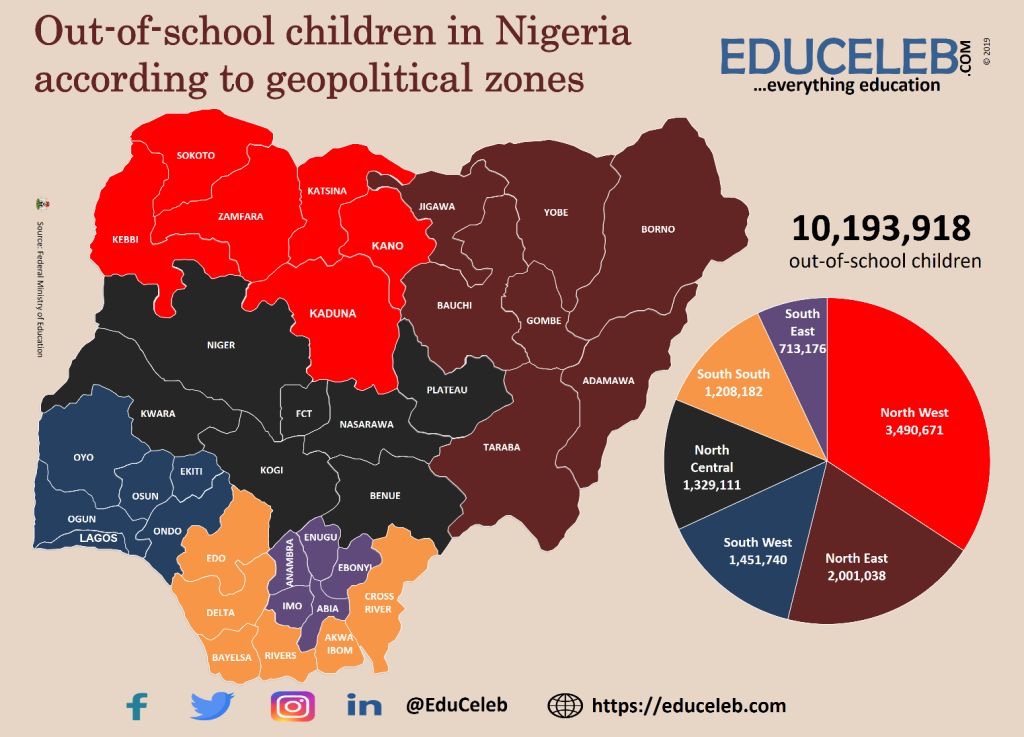
In Nigeria, there are many children which are out of school or are actually not in school. Here is a chart on our of school children in Nigeria according to Geopolitical Zone, this chart is based on EDUCELEB research and result.
Here, First is the North West of Nigeria has the highest population of out of school children in Nigeria with the total number of 3,490,671. The North West of Nigeria comprises of these state: Kaduna,Kebbi,Zamfara,Sokoto,Kano and Katsina.
Followed by the South West of Nigeria coming third with the total number of 1,461,740 out of school children in Nigeria. The South West comprises of these state:Oyo,Ogun, Lagos,Ekiti,Osun and Ondo.
Second is the North East of Nigeria which came second on the population of out of school children in Nigeria with the total number of 2,001,038. The North East comprises of these state: Jigawa,Yobe,Borno,Bauchi Gombe,Adamawa and Taraba.
The North Central followed with the total number of 1,329,111 out of school children in Nigeria. The North Central comprises of these state: Niger,Kwara,Kogi,FCT,Nasarawa,Benue and Plateau.
Next is the South South with the total number of 1,208,182 of out of school children in Nigeria. The South South comprises of these state: Edo,Delta,Bayelsa, Rivers,Always Ibom and Cross River.
The next which is the last with the smallest number of out of school children in Nigeria which is the South East with the total number of 713,176. The South East comprises of these state: Imo,Abia,Eboyin,Enugu, Anambra.
In conclusion, according to the Geopolitical Zone in Nigeria for out of school children combined, Nigeria has the total of 10,193,918 out of school children.
These chart shows that most children in Nigeria are having challenges of getting access to education which the government have to focus on targeting the issues and addressing them.
We offer data service and all kinds of cable subscription
Data plans to fit every budget 🤗
Below are some of the MTN, GLO, and AIRTEL data plan and prices. 500MB-₦200 1GB-₦300 2GB-₦600 3GB-₦900 4GB-₦1200 5GB-₦1500 6GB-₦1800 7GB-₦2000 8GB-₦2400 9GB-₦2650 10GB-₦2800 15GB-₦3900 20GB-₦5000 100GB-₦20000.
Validity is 30 Days. To order, kindly DM me or call 08139039655
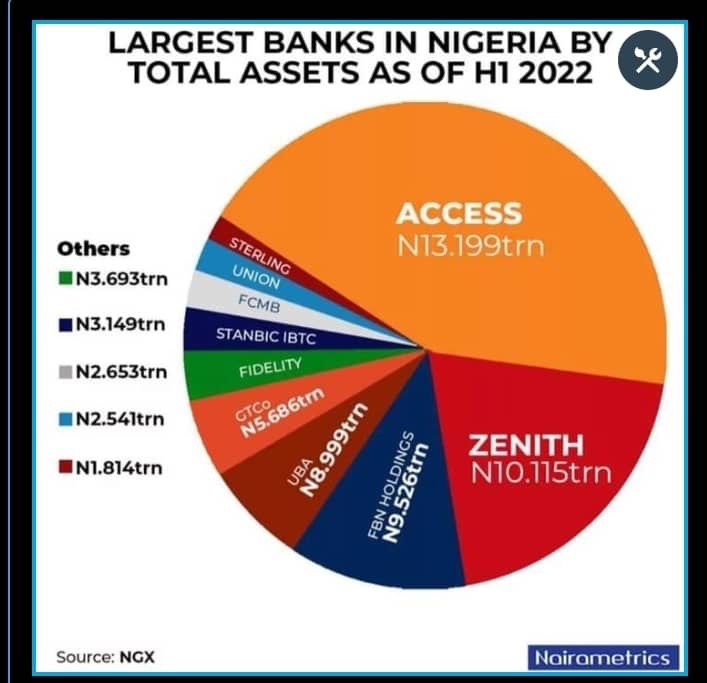
Zenith Bank’s total assets rose to N16.03 trillion in the first half of 2023, a 58.4 percent increase from N10.12 trillion recorded in the same period of 2022.
The bank’s total liabilities amounted to N14.25 trillion in the first half of 2023, from N8.84 trillion recorded in the same period of 2022.
Total shareholders’ equity amounted to N1.78 trillion in the period under review from N1.27 trillion in 2022.
Zenith Bank Plc is a financial service provider in Nigeria and Anglophone West Africa. It is licensed as a commercial bank by the Central Bank of Nigeria, the national banking regulator.
United Bank for Africa (UBA)
United Bank for Africa’s total assets grew by 70.9 percent to N15.38 trillion in the first half of 2023 from N9 trillion recorded in 2022.
The bank’s total liabilities increased to N13.67 trillion from N8.21 trillion in the period reviewed.
UBA’s total equity amounted to N1.7 trillion, from N0.79 trillion recorded in 2022.
United Bank for Africa Plc is a Multinational pan-African financial services group headquartered in Lagos and known as Africa’s Global Bank. It has subsidiaries in 20 African countries and offices in London, Paris, and New York. In December 2021, UBA received its banking license to commence operations in the UAE.
First Bank of Nigeria Holding Company
FBN recorded N14.18 trillion as its total asset in the first half of 2023 from N9.53 trillion recorded in the same period of 2022.
Total liabilities amounted to N12.8 trillion from N8.64 trillion recorded in the same period of 2022.
Total equity grew by 55 percent to N1.38 trillion from N0.89 trillion recorded in the same period of 2022.
Guaranty Trust Holding Company (GTCO)
Guaranty Trust Holding Company’s total assets stood at N8.51 trillion in the first half of 2023, up 49.5 percent from N5.69 trillion recorded in 2022.
The holding company recorded total liabilities which stood at N7.31 trillion from N4.84 trillion in the period reviewed.
Total equity amounted to N1.20 trillion in December 2022 from N0.85 trillion recorded in 2022.
Guaranty Trust Holding Company PLC also known as GTCO PLC is a multinational financial services group, that offers retail and investment banking, pension management, asset management and payments services, headquartered in Victoria Island, Lagos, Nigeria.
Access Bank Plc has earned a spot as the largest bank in Nigeria by total assets in the first half of 2023, according to BusinessDay.
The tier-one banks surveyed recorded an aggregate total asset value of N74.95 trillion in the first half of 2023, a 57.7 percent increase from N47.54 trillion in 2022. Their collective liabilities amounted to N67.15 trillion from N42.66 trillion recorded in the same period of 2022.
Access Bank’s total assets stood at N20.85 trillion at the end of June, representing a 30 percent share of the total assets of the tier-one banks surveyed.
The management examined the issue of indecent dressing among students in Kaduna poIytecnic indecent dressing is one of the major problems that is eating up our youths, especially female students and types of indecent dressing, reasons why some student dress indecently and its effects Counselling roles for curbing indecent dressing were also discussed. It was recommended, among others, that parents should sit up to their responsibilities and tertiary institutions should adopt dress codes for their student. The way students on these campuses of learning particularly, the female ones, dress seductively leaves much to be desired. What the ants. When they put on such dresses, they struggle to sit down, find difficulty in climbing machines, cross gutters as well as pick anything from the ground. Apart from the skimpy and tight fitting nature of these dresses, they are again transparent; revealing certain parts of the bodies that under normal dressing patterns ought to be hidden away from the glare of people.In the case of boys, their pattern of dress is different. It makes them to look so dirty and very unattractive with unkempt hairs and dirty jeans having pockets of holes deliberately created around the knees and the lower part of the trousers allowed to flow on the ground because they go through their heals into their legs as soucks.
So therefore the institution has lay down rules and regulations in regard to indesent dressing and their will be punishment attached to indesent dressing… So the management appeal to studentgirls call skirts that they wear is just “one inch” longer than their kneel to dress decently to avoid disgrace and embrasement….
Data-driven journalism allows journalists to go beyond anecdotal evidence and personal opinion by using hard data to support their stories. It enables them to ask more in-depth questions, identify hidden connections, and provide a more comprehensive and accurate picture of complex issues.
In data-driven journalism, journalists often work with data scientists or data analysts to collect and clean data, perform statistical analysis, and create visualizations that make the data more accessible and understandable for readers. This collaboration between journalists and data experts helps ensure that the data is accurately interpreted and presented in a way that is engaging and informative.
Data-driven journalism can cover a wide range of topics, from political and economic issues to environmental concerns and social justice. It can involve analyzing government datasets, conducting surveys and interviews, scraping data from websites, and using other data sources to uncover stories that might otherwise go unnoticed.
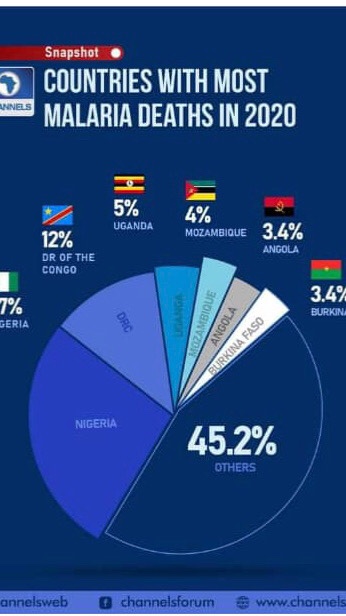
Each year, the World Health Organization’s World Malaria Report assesses global and regional malaria trends, highlights progress towards global targets, and describes opportunities and challenges in controlling and eliminating the disease. Below are some of the highlights from the most recent report.
Malaria can kill within 24 hours of symptom onset.
Globally, there were an estimated 247 million malaria cases in 2021 in 84 malaria endemic countries (including the territory of French Guiana), an increase from 245 million in 2020, with most of this increase coming from countries in the WHO African Region. In 2015, the baseline year of the Global technical strategy for malaria 2016–2030 (GTS), there were an estimated 230 million malaria cases.
Globally, malaria deaths reduced steadily over the period 2000–2019, from 897 000 in 2000 to 577 000 in 2015 and to 568 000 in 2019. In 2020, malaria deaths increased by 10% compared with 2019, to an estimated 625 000. Estimated deaths declined slightly in 2021 to 619 000. Between 2019 and 2021, there were 63 000 deaths that were due to disruptions to essential malaria services during the COVID-19 pandemic.
The percentage of total malaria deaths in children aged under 5 years reduced from 87% in 2000 to 76% in 2015. Since then there has been no change.
About 96% of malaria deaths globally were in 29 countries. Four countries accounted for just over half of all malaria deaths globally in 2021: Nigeria (31%), the Democratic Republic of the Congo (13%), the Niger (4%) and the United Republic of Tanzania (4%).
In 2021, in 38 moderate and high transmission countries in the WHO African Region, there were an estimated 40 million pregnancies, of which 13.3 million (32%) were exposed to malaria infection during pregnancy.







 Happiness blogging site